
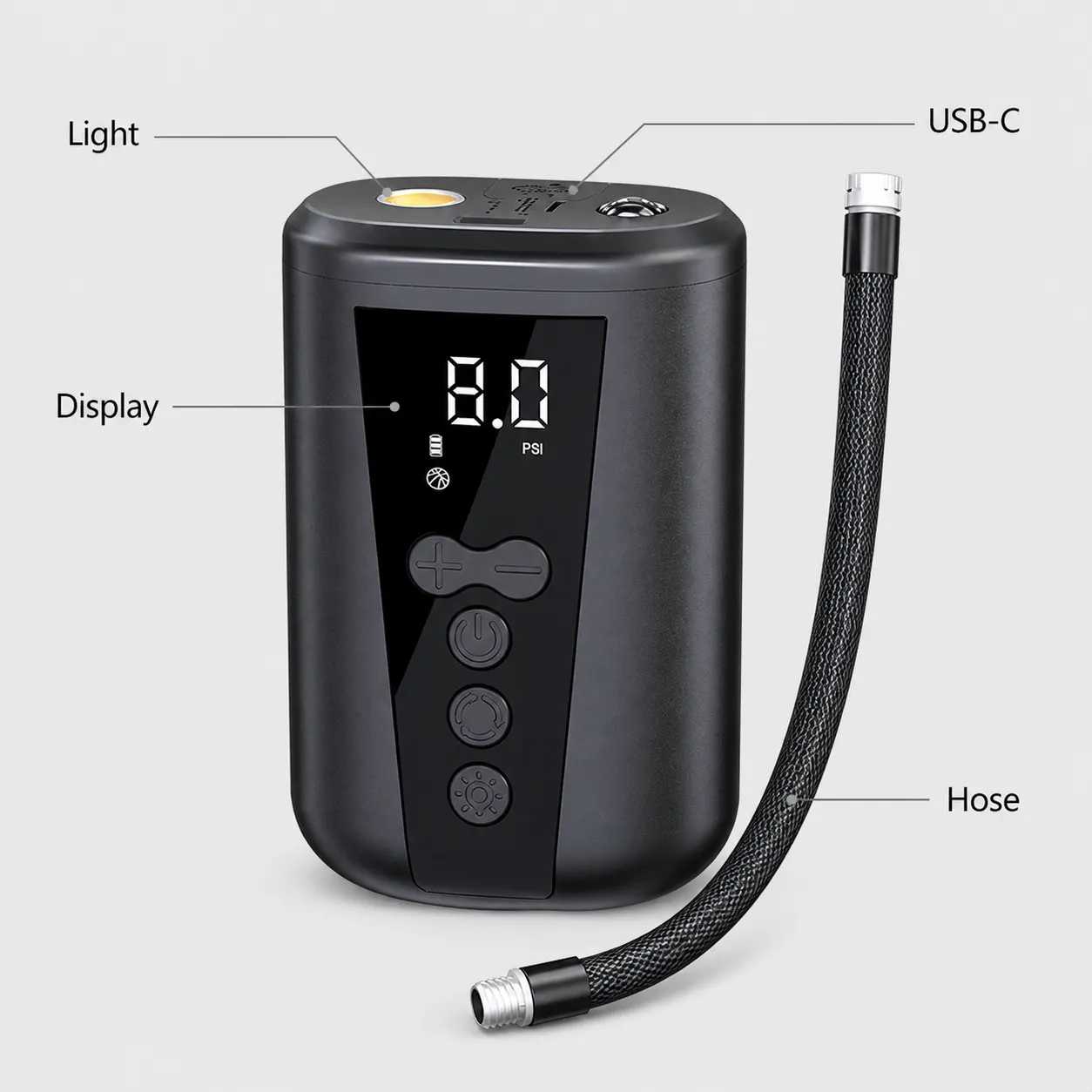
Short answer: An electric football pump for match balls should fit the ball valve, show a usable pressure reference and remain ready in the kit bag. Ballpump lists the ST-9612 for footballs, basketballs and volleyballs, with a digital display, USB power and charging functions, lighting, ABS construction and a 263 g net weight. Manufacturer does not specify the needle, pressure range, units, display accuracy, airflow, inflation time, auto-stop or battery runtime. For football, use the ball maker's marking and relevant competition rules as the pressure target, then verify the pump's interface and range before purchase.
Start with the match-ball interface
A sports-ball pump needs a needle that matches the football valve and can be inserted straight without damaging either part. The ST-9612 page identifies football use, but manufacturer does not specify whether a needle is included, its thread or fitting size, the hose arrangement or compatible replacement needles.
Check the box contents and the exact pump-to-needle connection before ordering. Also inspect the football valve and surface before inflation. A ball that repeatedly loses air, has a distorted panel or has a damaged valve needs attention; adding more pressure is not a repair.
| Match-day field | Published detail | Confirm before relying on it |
|---|---|---|
| Ball scope | Football, basketball and volleyball | Exact ball valve and intended needle |
| Pressure view | Digital display | Units, range, accuracy and calibration |
| Power | USB power and charging functions | Cable, input, capacity and runtime |
| Portability | 263 g net weight | Dimensions and protected storage |
Set pressure from the ball and competition
The IFAB Laws of the Game state that a football used under Law 2 has a pressure of 0.6 to 1.1 atmosphere at sea level. That is a rules range for the ball, not a claimed capability or preset of the ST-9612. For a particular match ball, follow its printed pressure marking and the competition's requirements.
The product page confirms only that a digital display is present. Manufacturer does not specify pressure units, range, accuracy or calibration, so the display should not be described as a certified match gauge. If a precise competition check matters, compare it with suitable documented equipment.
Build a repeatable pre-match routine
A coach can reduce hurried over-inflation by checking all match and warm-up balls together before players arrive. The routine should use the same ball markings, the same suitable needle and small corrections rather than long uncontrolled runs.
Lighting may help a user see the pump in a dim store room or evening kit check, but the page does not state its brightness or runtime. Keep the pump, charging lead and verified needle together, and charge it before travel because manufacturer does not specify battery endurance.
- Read the pressure marking on each football and note the competition requirement.
- Inspect the cover and valve, then fit the correct needle straight into the valve.
- Add air in controlled increments while monitoring the displayed value.
- Stop at the ball's stated target and separate any ball that will not hold pressure.
- Store the pump, USB lead and needle together after the session.
Limits and checks before buying
The documented sports-ball scope and 263 g weight make the ST-9612 relevant to a coach who wants a portable electric option for footballs. The same evidence does not support tyres, air beds, large inflatables or workshop compressor work.
Manufacturer does not specify needle contents, pressure range, units, accuracy, calibration, auto-stop, airflow, inflation time, battery capacity, runtime, dimensions, duty cycle or ingress protection. Confirm every field that affects your match-day routine before depending on the pump.
Related guides and product details
Shortlist the ST-9612 for match balls only after the needle connection, displayed units and pressure range are confirmed against the balls you actually use. Read Football Pump with Pressure Gauge: What to Verify for related guidance. Read Portable Ball Pump for a Football Coach: Kit Check for related guidance. Review the documented specification on the ST-9612 Black USB Electric Ball Pump product page before ordering.
Sources and safety context
- Supports the ST-9612 identity, sports-ball use, display, USB and lighting functions, ABS material, 263 g weight and specification limits. Current Ballpump USB electric ball pump product page.
- Supports the official football pressure range and the need to treat ball requirements separately from pump claims. The IFAB Laws of the Game, Law 2: The Ball.