
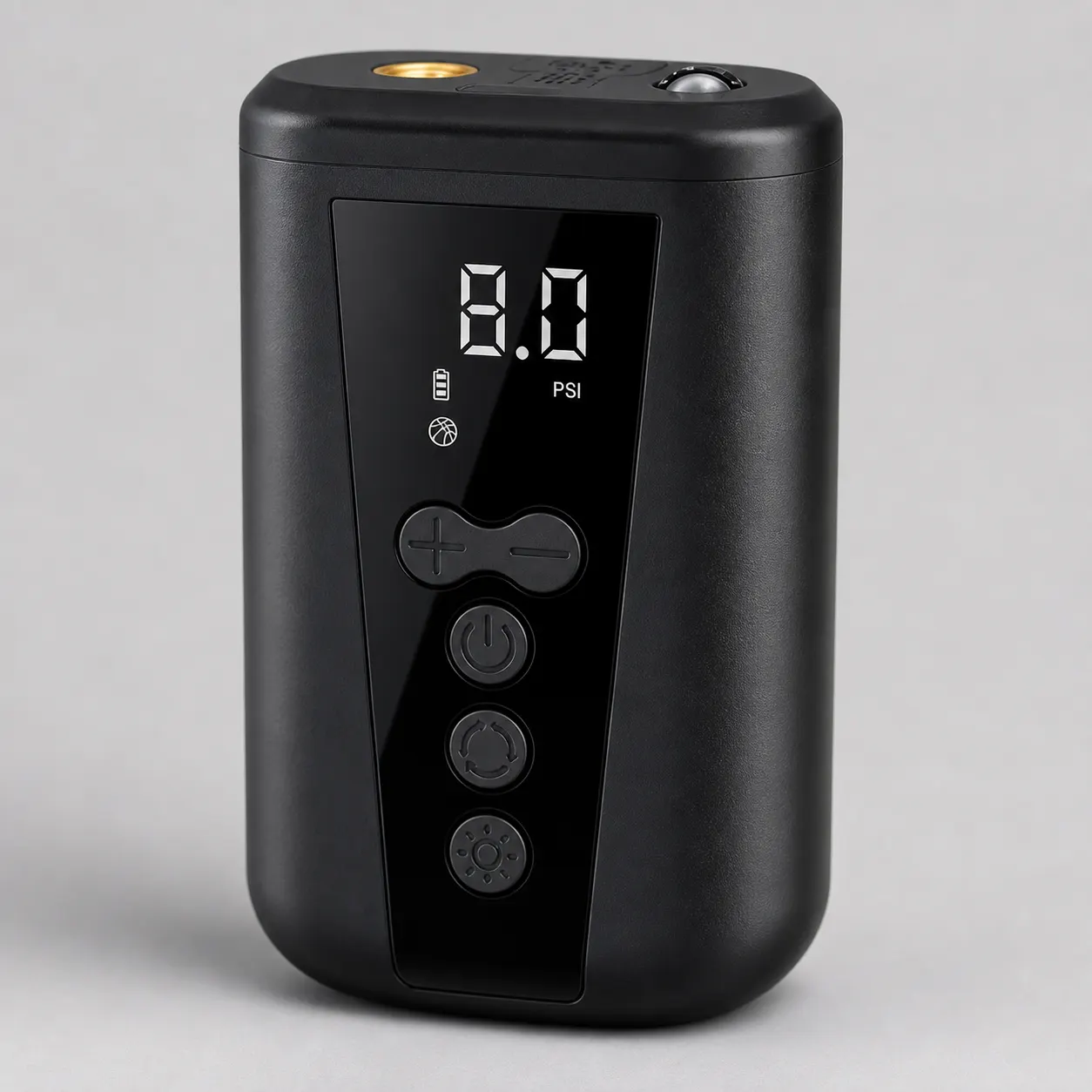
Short answer: A portable ball pump for a football coach should be easy to carry, ready before warm-up and compatible with the team's ball valves. The ST-9612 is listed at 263 g and for football, basketball and volleyball, with a digital display, USB power and charging functions, lighting and ABS material. Manufacturer does not specify dimensions, battery capacity, runtime, charging input, needle contents, pressure range, accuracy, inflation speed or water resistance. Check the exact kit contents and ball pressure markings before buying, then decide whether the pump can be stored and charged reliably for your weekly coaching routine.
Fit the pump into a real coaching kit
A coach's bag already carries footballs, bibs, cones, tape and paperwork. The listing's 263 g net weight is therefore a relevant portability fact. Manufacturer does not specify the pump dimensions or a storage case, so weight alone cannot show how neatly the unit and accessories will fit.
Decide where the pump, USB lead and needles will live between sessions. Small inflation accessories are easy to lose when they do not have a fixed pouch. Confirm the supplied contents because the current page does not list a needle, adapter or charging cable.
| Kit-bag check | Published detail | Missing detail to resolve |
|---|---|---|
| Weight | 263 g net | Overall dimensions and case |
| Charging | USB power and charging functions | Input, lead, battery capacity and charge time |
| Ball connection | Football use listed | Needle fitting and spares |
| Pitch conditions | Lighting function | Ingress rating and operating limits |
Plan charging before the fixture
USB charging can suit portable coaching equipment because the pump does not need a mains socket beside the pitch. It still needs a known charging routine. Manufacturer does not specify battery capacity, runtime, charge time, USB connector or whether the pump can operate while connected to power.
Charge and check the unit before leaving, but keep a simple fallback if the device is flat or an accessory is missing. Do not promise a number of balls per charge or an inflation time, because the current listing gives neither figure.
- Check the pump, USB lead and correct needle the day before use.
- Read each football's pressure marking and inspect its valve.
- Top up match balls before players begin warm-up.
- Separate any ball that leaks or shows damage instead of repeatedly inflating it.
- Return all small accessories to the same dry pouch after the session.
Keep pressure decisions tied to the football
IFAB Law 2 states an official football pressure range of 0.6 to 1.1 atmosphere at sea level. A coach should also follow the individual ball's marking and competition rules. The ST-9612 display can be part of that check, but the product page does not establish its units or measurement accuracy.
Manufacturer does not specify automatic stop or sport presets. Add air in controlled increments and stop at the documented target rather than assuming the pump will stop itself. If accuracy is important for competition preparation, use a suitable pressure gauge with published performance.
Limits and checks before buying
The listed sports-ball scope, USB functions and 263 g weight make this product relevant to portable coaching use. The page does not claim heavy equipment-room duty, wet-weather protection or suitability for tyres and large inflatables.
Manufacturer does not specify dimensions, ingress rating, needle contents, pressure range, units, accuracy, airflow, inflation time, duty cycle, battery capacity or runtime. Confirm the exact accessories and environmental limits before making it the only pump in a match-day bag.
Related guides and product details
Buy for the coaching bag only when the needle, pressure display, charging kit and storage arrangement are all confirmed, with a backup for match day. Read Electric Football Pump for Match Balls: UK Checks for related guidance. Read Football Pump with Pressure Gauge: What to Verify for related guidance. Review the documented specification on the ST-9612 Black USB Electric Ball Pump product page before ordering.
Sources and safety context
- Supports the listed ball types, USB and lighting functions, ABS material, 263 g weight and boundaries of the current specification. Current Ballpump USB electric ball pump product page.
- Supports the official football pressure range and the separation between ball requirements and pump capabilities. The IFAB Laws of the Game, Law 2: The Ball.